The whole loop: how Dealerloop runs a dealership's leads from first enquiry to next car
One platform that captures every enquiry, answers in seconds, books the test drive, runs the delivery and keeps the owner. Here is the end-to-end walk.
Most dealerships do not have a lead problem. They have a leakage problem. Enquiries land in six inboxes, get answered twice or never, warm buyers reach a salesperson who starts from scratch, sold cars kill their own lead lists, and the fortnight after handover passes in silence. Every stage loses a little, and the losses compound.
Dealerloop is built to close each of those gaps in one connected system, so a lead that arrives at 11pm can be answered, qualified, booked, delivered and followed up without falling through a crack. Here is everything Dealerloop does, walked from the first enquiry to the next car.
Capture every lead, one front door
carsales, Gumtree, Facebook, Drive, AutoGate, your website and raw email all feed the same engine. Lead providers push ADF/XML straight to a per-dealer secured endpoint, forwarded lead emails are parsed for the customer's actual comments and the vehicle they asked about, and website and Facebook forms flow through the identical pipeline. One front door instead of six inboxes to scramble across.
Once a lead is in, it stays one person. Phone numbers are normalised to a single Australian format, so 0412, +61412 and spaced variants all resolve together, and an inbound text is matched to the customer's open lead across channels, not just the one it arrived on. The full conversation history rides along, so the assistant never re-asks what the buyer already answered.
Underneath it all sits inventory that keeps itself current. Your full website stock imports with photos, prices, kilometres and real stock numbers, synced hourly or daily, and it scales to yards of 1,700 or more vehicles. A car that drops out of the feed is marked sold rather than deleted, which quietly powers recovery later on.
Respond in seconds, day and night
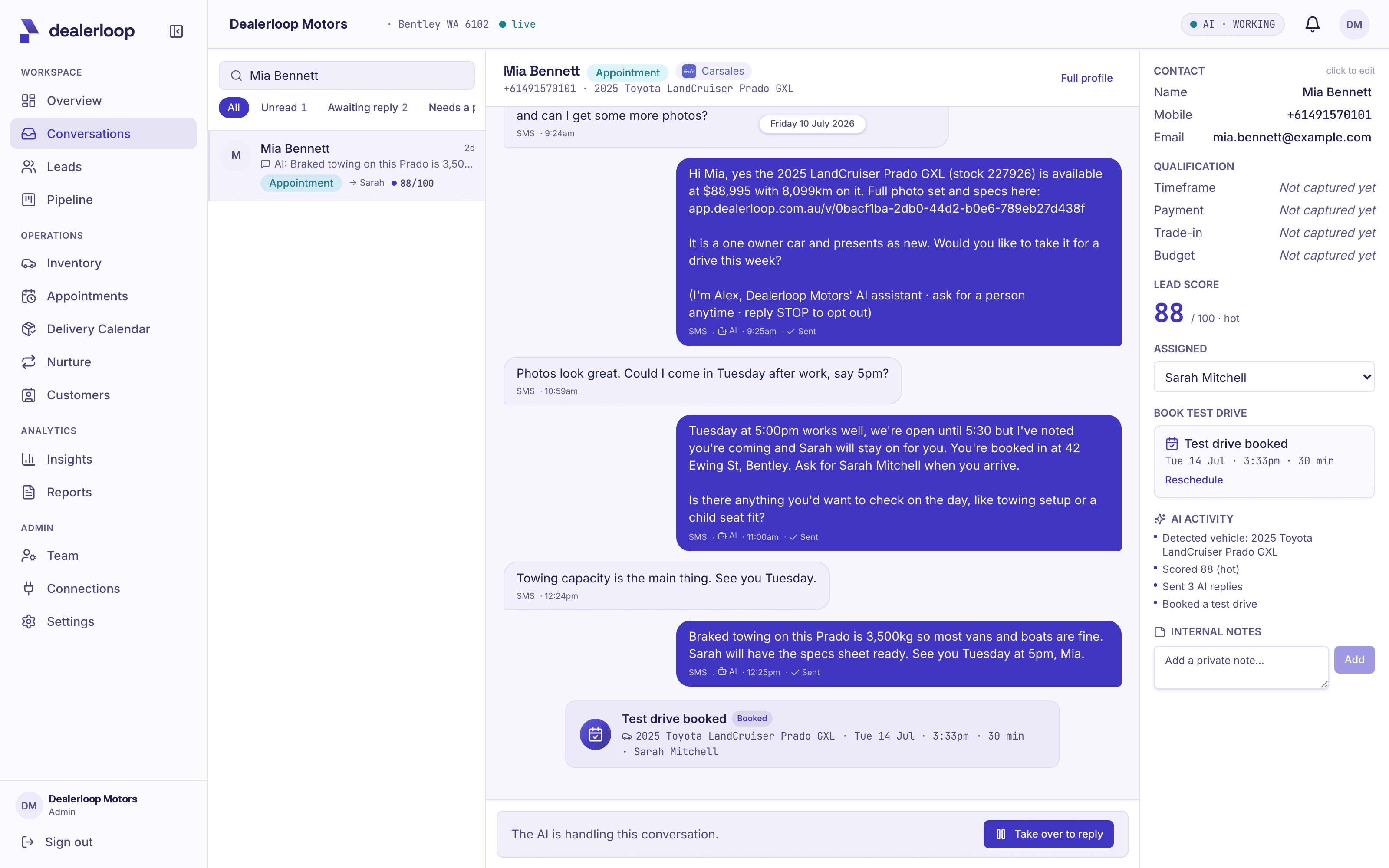
The first dealer to reply usually wins, and most enquiries arrive when the showroom is busy or shut. Dealerloop replies within seconds on the customer's channel: SMS where there is a mobile, email otherwise. After-hours enquiries get the same instant first response; quiet hours only defer outbound marketing, never a reply to a live buyer. Every lead records its first-response time, so the speed is measurable per lead.
Those replies are grounded in your actual stock. The assistant reads the enquired vehicle's live record for price, kilometres, stock number, body, transmission and availability, and answers from that. A price guard means it can only state prices that exist on the record, and discount negotiation is deflected to your sales team rather than invented.
It is also honest about what it is. The assistant has a name you choose, introduces itself as the dealership's AI, never claims to be human, offers a route to a person at any time, and honours STOP on the spot. Ask for photos and it texts a fast, hosted page with the full gallery, specs and price, and records the moment the customer opens it as a buying signal on the timeline.
Qualify, book and hand over
Budget, timeframe, trade-in and finance are learned in conversation, one question at a time, not front-loaded into a ten-field form that kills conversion. Answers accumulate as structured qualification data with a lead score that firms up as intent does.
When a buyer is ready, the assistant books the test drive inside the chat: it proposes and agrees a time against your real opening hours, creates a calendar appointment assigned to a consultant, and confirms the address and who to ask for. If someone does not show, a warm, no-guilt message offers a new time the same day, and cancellations get the same graceful second chance.
Handovers come with a written brief. Triggers are yours to configure: price negotiation, finance talk, a request for a person, or the AI judging the lead is ready. The assigned consultant inherits the car, what the customer said about budget, trade and timing, and what to do next, then the AI pauses itself so two voices never talk over each other.
Every SMS and email conversation, AI and human, lives in one shared inbox that updates in realtime, filterable by status, source, consultant or channel. And warm leads spread by manager-set weights to whoever is furthest behind their fair share over a rolling 30-day window, so distribution is not won by the fastest cherry-picker.
Recover the ones that got away
This is where the sold-car database becomes an asset instead of a graveyard. Nothing in budget today? The assistant offers to watch for the buyer, captures their criteria, and checks every arriving or re-listed vehicle against active watches within 15 minutes, then sends one grounded message with the actual car. Read more on the back-in-stock waitlist.
When an enquired-on car sells, every open enquirer gets one honest update with genuinely similar in-stock alternatives, and each lead hears about each sold car at most once, enforced at the database level. Slower leads get multi-step nurture with per-step AI guidance generated fresh against their context, including price-drop alerts on the exact car they asked about, always consent-aware and quiet-hours-aware.
Run the delivery
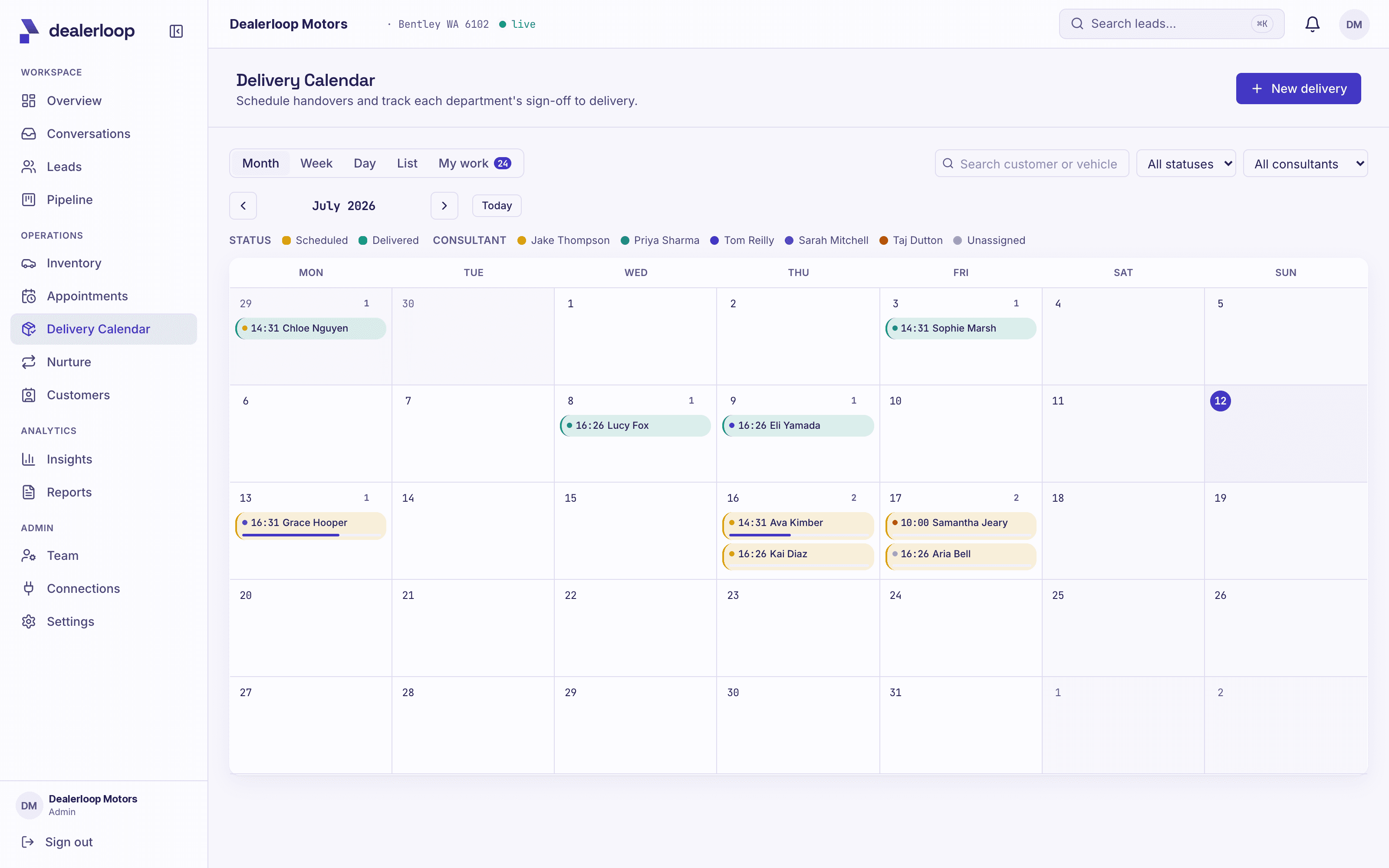
Won deals become scheduled deliveries on one board, with a checklist split across licensing, finance, service, sales and management. Each department sees its own outstanding items first; managers see everything, colour-coded by progress. A handover inside the notice window can only be booked as a rush request, which routes to a manager for a yes or no with the reason on record.
Upload the signed contract once and the customer, vehicle and trade-in are read out of it automatically, matched to existing records or created cleanly, with provenance tagged so later DMS data can win. The delivery record and WA licensing transfer form prefill from the same capture, and the form goes to the customer for e-signature pinned to the right fields. Booking, rescheduling and the day-before reminder all text the customer automatically, respecting quiet hours and consent.
Keep the customer
The fortnight after handover decides the review, the service relationship and the referral. Delivered customers can enrol in post-delivery follow-up automatically, with the vehicle and delivering consultant woven in, a review ask that uses your exact Google link, and problems routed to the team rather than a form. Won leads become customer records linked to the vehicles they own, with delivery history and consent in one place: an owner base ready for future service, trade-in and repeat-purchase campaigns.
Run the dealership on it
A monthly report covers the full lifecycle: lead volume by source, first-response speed, outcomes, appointments, wins with sale values and delivery throughput, with return on ad spend computable per source. A daily digest lands each morning and dashboards update live in between. Spam Act compliance is enforced by the engine, not by training and hope: immediate opt-outs on both channels, quiet hours per timezone, and a functional opt-out on every commercial message. Groups run shared-stock rooftops as locations or separate-stock rooftops as linked dealerships, with one login, per-rooftop personas and group-level rollups.
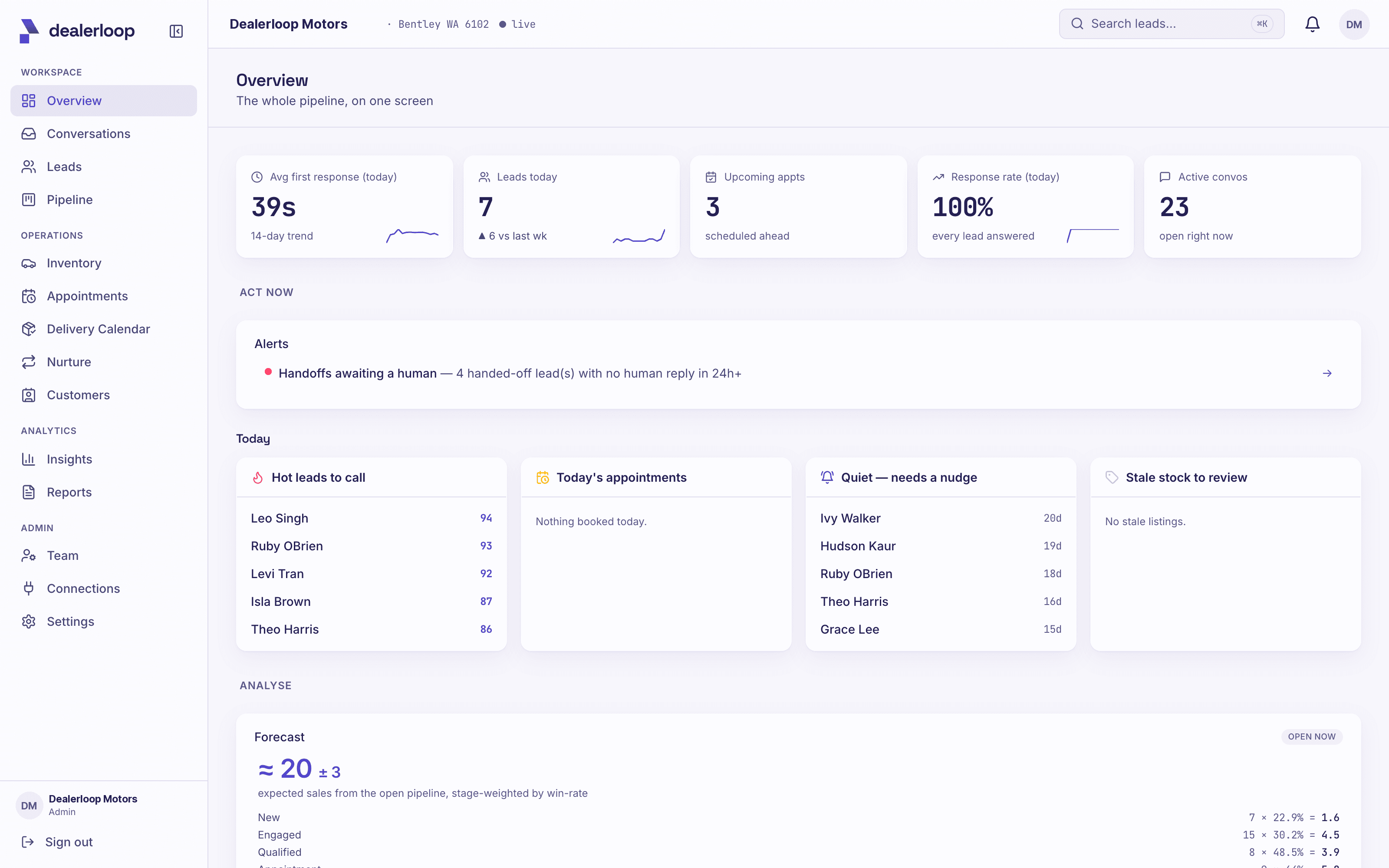
Capture, speed, qualification, recovery, delivery and retention are worth something on their own. Wired together, each one feeds the next, and the leaks stop compounding. Book a demo and we will walk your dealership's own journey through it.
Frequently asked questions.
- Which lead sources does Dealerloop connect to?
- carsales, Gumtree, Facebook, Drive, AutoGate, your website and raw email all feed the same engine. Lead providers can push ADF/XML directly to a per-dealer secured endpoint, forwarded lead emails are parsed for the customer's comments and vehicle, and website and Facebook forms flow through the same pipeline, so every source gets the identical instant-response treatment.
- How does the AI avoid quoting the wrong price or a car you no longer have?
- It answers from the enquired vehicle's live stock record: price, kilometres, stock number, body, transmission and availability. A price guard means it can only state prices that exist on that record, and inventory syncs hourly or daily. A car that drops out of the feed is marked sold, not deleted, which triggers honest sold-car updates to open enquirers.
- What happens when a human takes over a conversation?
- Handoff triggers are dealer-configured, such as price negotiation, finance talk, a customer asking for a person, or the AI judging the lead is ready. The assigned consultant receives a written brief covering the vehicle, budget, trade-in, timing and next steps, and the AI pauses itself so two voices never talk over each other in one thread.
See what closing the loop is worth on your own numbers.