Inventory that keeps itself current: how Dealerloop's AI always quotes real stock
Stock moves daily. Here is how Dealerloop makes your website inventory the AI's single source of truth, refreshed on your schedule, at any yard size.
Stock moves daily. A car that was on the lot Monday is delivered by Thursday, and the price on a unit can shift twice in a week. Now picture an assistant confidently quoting last week's cars to a live buyer. One message like that, and the trust is gone. The customer stops believing anything the dealership tells them, and you never get it back.
That is the problem Dealerloop's inventory engine exists to solve. The AI never speaks from a stale spreadsheet or a rep's memory. It speaks from your live stock list, and only your live stock list.
Your website becomes the source of truth
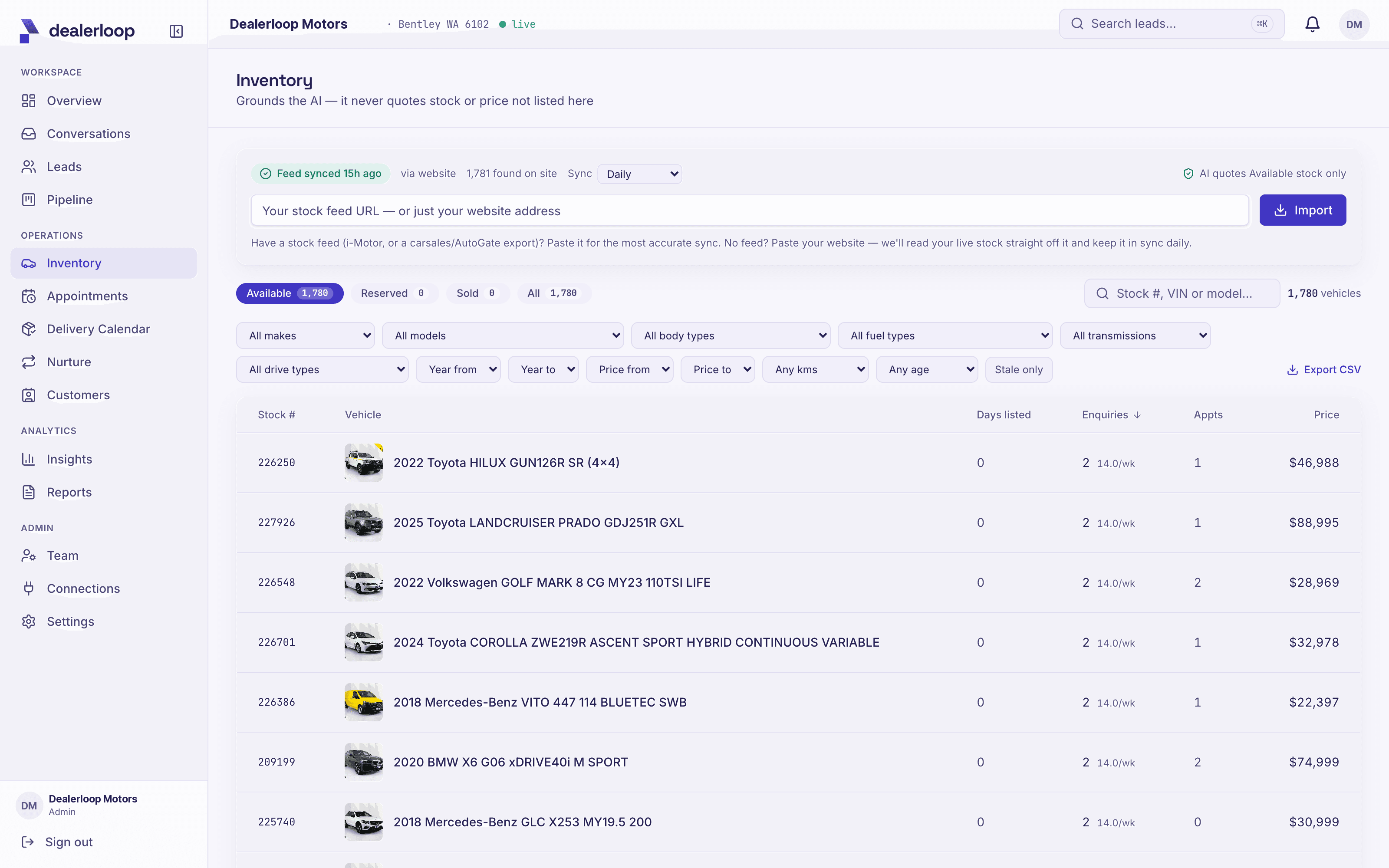
Dealerloop imports your full website inventory: photos, prices, kilometres and the real stock numbers you use on the floor. That import is not a one-off. It stays synced on a schedule you choose, either hourly or daily, so the picture the AI works from matches the picture a customer sees when they land on your site.
Where your website platform provides a direct feed, we support that too. Either way, the principle holds: the AI only ever quotes what is actually in stock. If a car is not there, it says so instead of guessing. No invented specs, no phantom units, no quoting a car that rolled off the lot yesterday.
This capability sits at the very start of the journey, where Dealerloop works to capture every lead from every channel and match it to one customer. Accurate stock is what makes those first replies worth sending.
Built for volume, not just tidy yards
Plenty of tools cope fine with a small, curated list. The floor is different. Dealerloop is built for volume: yards of 1,700 vehicles and more import completely, with filtering and search designed for large used inventories. Nothing gets dropped because the list got long.
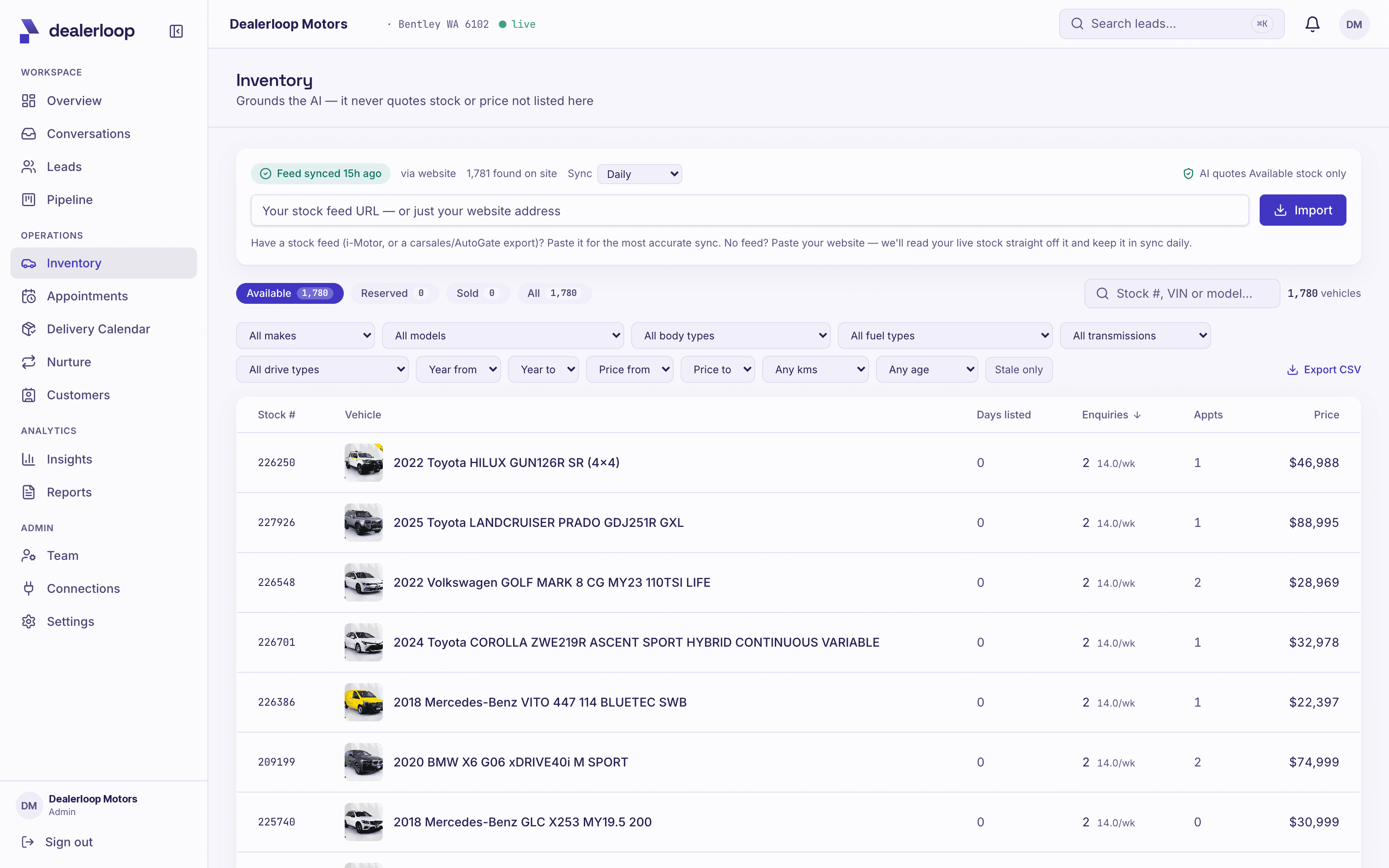
That matters because a big used operation is exactly where stale data does the most damage. The more units you carry, the more movement there is every single day, and the harder it is for any person to keep it all in their head. The engine does that part so your people can focus on the conversation.
Sold cars do not just vanish
Here is a detail that changes what happens after the sale. When a vehicle disappears from the feed, Dealerloop marks it sold rather than deleting it. That single decision powers two things.
First, it drives sold-car follow-up, so a unit leaving the lot becomes a reason to reconnect rather than a dead record. That is part of how Dealerloop gives dead leads a second chance.
Second, it feeds the back-in-stock waitlist, so when the right car lands again, the buyer who walked away is the one it finds. A car that simply got deleted could never do either job.
What it means on the floor
Day to day, this is quiet infrastructure that shows up as trust. A customer asks about a specific car, and the answer is right, because it came straight from your live list. When enquiries arrive from every channel and land in one front door, and each buyer stays in one thread, the stock behind every reply is current. Your team stops fielding awkward corrections and starts having conversations that move.
Want to see your own stock list running inside Dealerloop? Book a demo and we will walk you through it.
Frequently asked questions.
- How does Dealerloop sync a dealership website inventory with the CRM?
- Dealerloop imports your full website inventory, including photos, prices, kilometres and real stock numbers, then keeps it synced on an hourly or daily schedule you choose. Where your website platform provides a direct feed, that is supported too. Your website stock list becomes the single source of truth the AI works from.
- Does the AI actually know the dealership's current stock list?
- Yes. The AI only ever speaks from your imported inventory. If a car is not in stock, it says so rather than guessing, so customers never get quoted a car that has already sold.
- Can it handle a large used yard?
- It is built for volume. Yards of 1,700 vehicles and more import completely, with filtering and search designed for large used inventories, so nothing gets dropped as the list grows.
See what closing the loop is worth on your own numbers.