Capture every lead: one front door for every enquiry, matched to one customer
Enquiries arrive across six channels and get answered twice or not at all. Here is how Dealerloop lands every one in a single engine, matches it to the right buyer, and quotes only real stock.
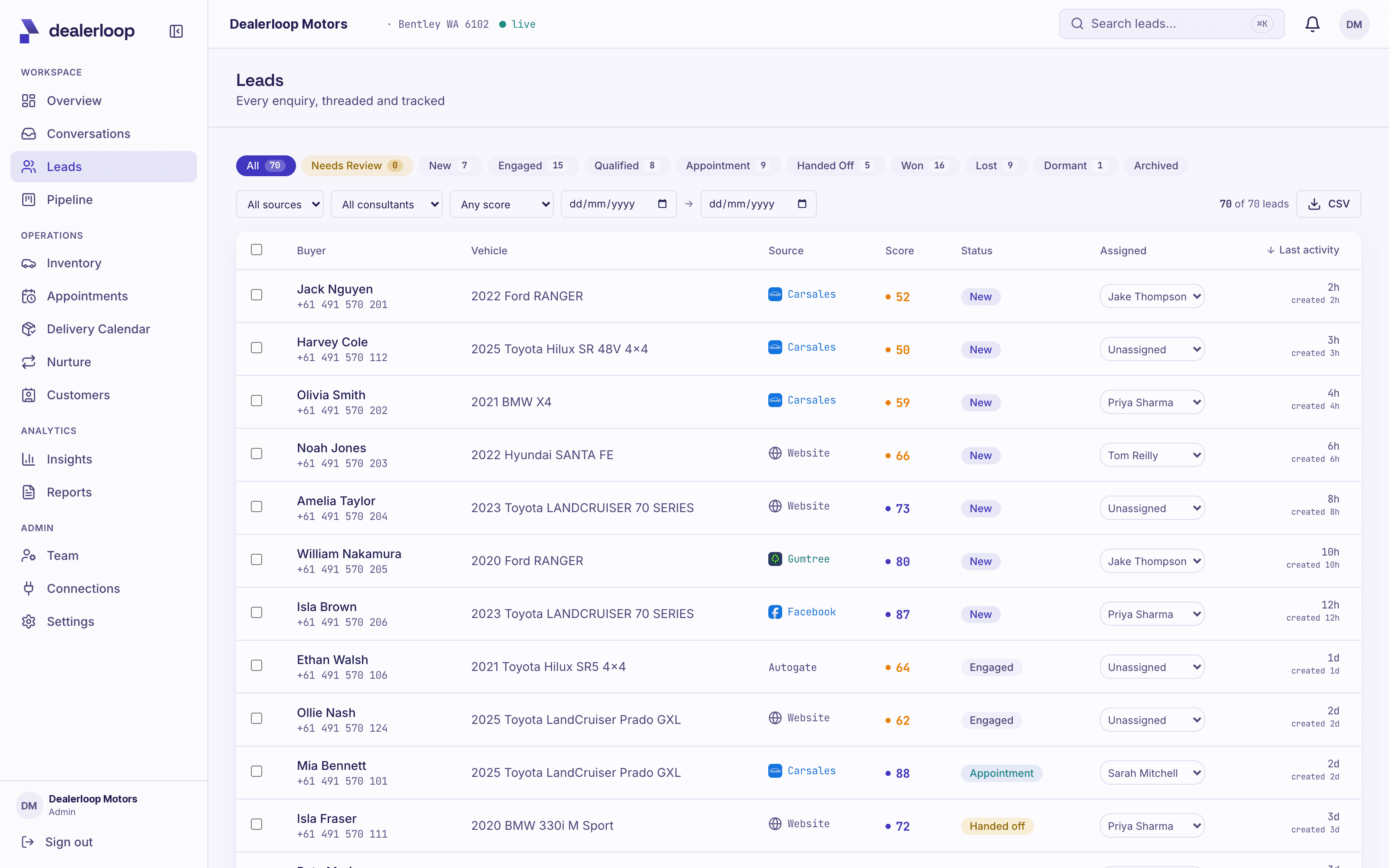
Ask any dealer principal where their leads live, and the honest answer is: everywhere. carsales in one tab, AutoGate in another, Gumtree and Facebook on someone's phone, Drive and the website form dropping into a shared inbox, plus raw emails that get forwarded around until they go cold. Some enquiries get answered twice by two salespeople. Some never get answered at all.
The first job of Dealerloop is to end that scramble. Every enquiry, from every channel, lands in one place and is matched to one customer. This is the "Capture every lead" stage, and it is the foundation everything else sits on. Here is how the pieces work, and why they are stronger together than apart.
Every lead source, one front door
Dealerloop runs formal integrations with carsales and AutoGate, so enquiries from those portals arrive straight in the engine. The same pipeline accepts ADF/XML from Drive and most other lead providers and DMS platforms, delivered to a per-dealer secured endpoint. Website enquiry forms and Facebook leads flow through the identical path.
And for everything else, there is email. Dealerloop parses lead emails forwarded to a per-dealer ingestion address, pulling out the customer's actual comments and the vehicle they asked about, not just a name and a number.
The point is not that Dealerloop connects to a lot of sources. The point is that every source gets the same instant-response treatment. A Gumtree enquiry at 9pm is handled exactly like a carsales lead at 9am. No channel is a second-class citizen, and nothing falls between the cracks of who was watching which inbox.
We go deeper on this in Every lead source, one front door: ending the six-inbox scramble.
One customer, one thread
Here is where the compounding starts. A buyer emails about a ute on Monday, then texts you on Tuesday from the number in your ad. To most systems, that is two leads. To your salespeople, it is two conversations that repeat the same questions and annoy the customer.
Dealerloop recognises them as the same person. Phone numbers are normalised to a single Australian format before matching, so 0412..., +61412... and spaced variants all resolve to one customer. An inbound text or email is matched to that customer's open lead across channels, not just within the channel it arrived on.
The full conversation history rides along, so the assistant never re-asks what the buyer already answered somewhere else. One customer, one thread, one coherent conversation.
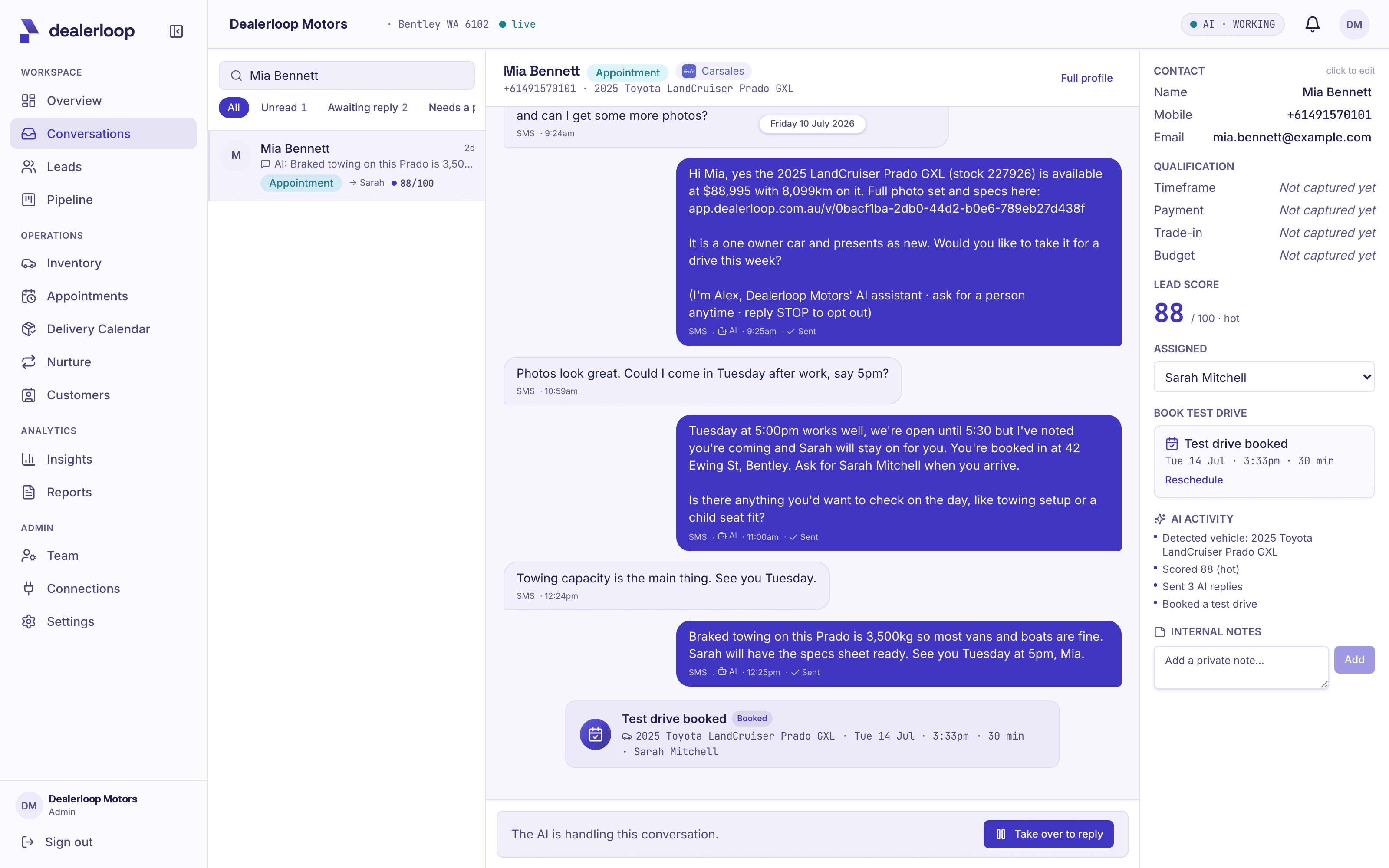
That matters because a fragmented buyer is a lost buyer. More on the mechanics in One customer, one thread: how Dealerloop stops one buyer from becoming three leads.
Inventory that keeps itself current
Capturing the enquiry is only half the trust equation. The other half is answering it accurately. Stock moves daily, and an assistant quoting last week's car destroys trust in a single message.
So Dealerloop treats your website's stock list as the source of truth. It imports your full website inventory, including photos, prices, kilometres and real stock numbers, and keeps it synced on an hourly or daily schedule you choose. It is built for volume: yards of 1,700 or more vehicles import completely, with filtering and search designed for large used inventories.
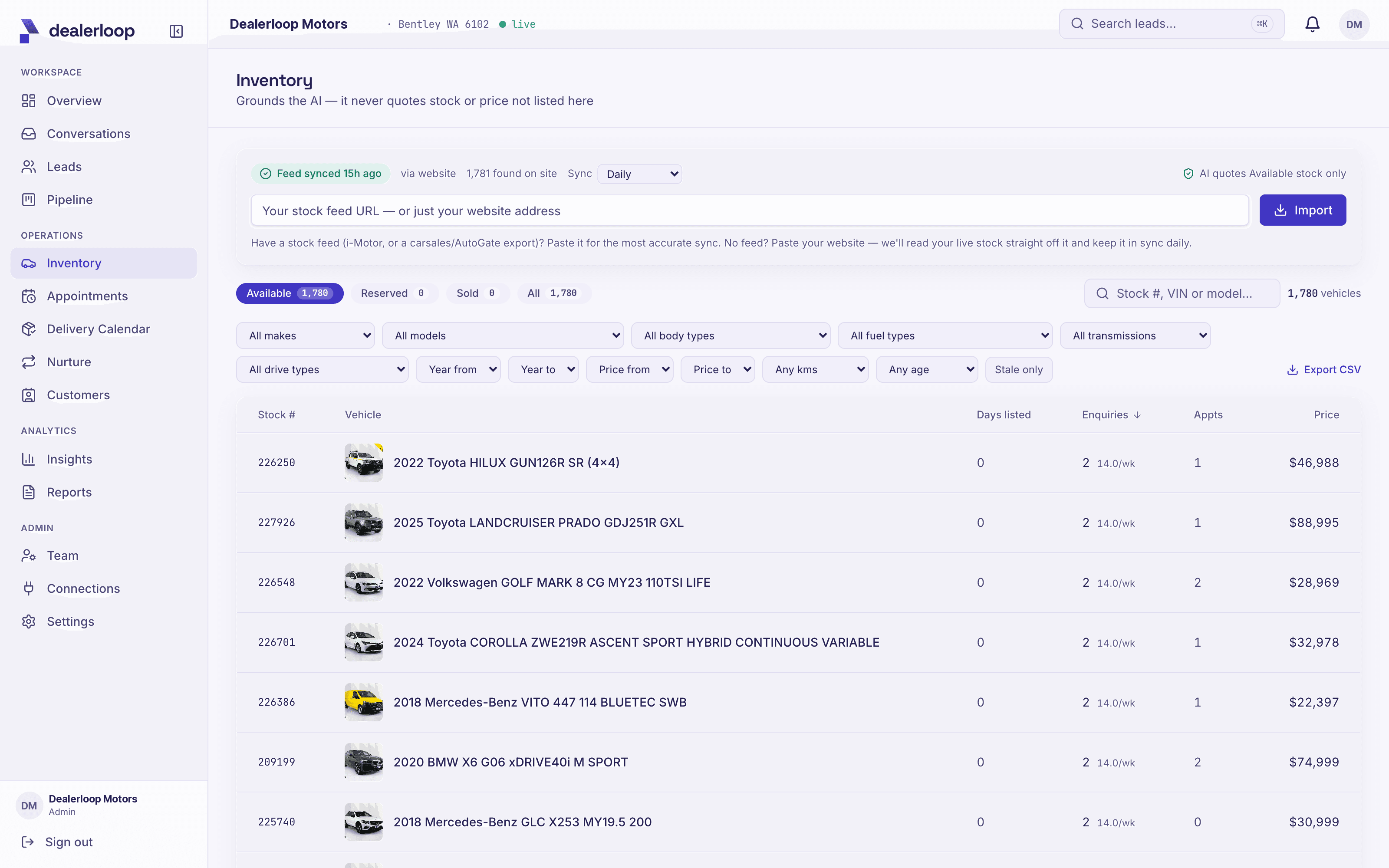
There is a quiet but powerful detail here. When a vehicle disappears from the feed, it is marked sold rather than deleted. That single decision powers sold-car follow-up and the back-in-stock waitlist, turning what used to be a dead end into a second chance.
Why the three work better together
Run these three capabilities at once and the effect compounds. Every enquiry arrives in one engine. Every enquiry is tied to the right customer with their full history. And every reply is grounded in stock that is actually on your yard right now.
That is the difference between a dealership that reacts to whichever lead happens to be visible, and one that captures the whole picture, every time. It is also what makes the later stages possible, from booked test drives to recovering the enquiries that got away. See how it all connects in the whole loop, or browse everything Dealerloop does.
Want to see your own lead sources landing in one place? Book a demo and we will walk you through it with your channels.
Frequently asked questions.
- Which lead sources does Dealerloop connect to?
- Dealerloop has formal integrations with carsales and AutoGate, and the same pipeline accepts ADF/XML from Drive and most other lead providers and DMS platforms on a per-dealer secured endpoint. Website enquiry forms, Facebook leads and raw emails forwarded to a per-dealer ingestion address all feed the same engine, so every source gets the identical instant-response treatment.
- How does Dealerloop know two enquiries are the same customer?
- Phone numbers are normalised to a single Australian format before matching, so 0412..., +61412... and spaced variants all resolve to the same person. An inbound text or email is matched to that customer's open lead across channels, and the full conversation history travels with it, so nothing already answered gets re-asked.
- How does Dealerloop keep the AI quoting current stock?
- It imports your full website inventory, including photos, prices, kilometres and real stock numbers, and syncs on an hourly or daily schedule you choose. It handles yards of 1,700 or more vehicles, and a car that leaves the feed is marked sold rather than deleted, which powers sold-car follow-up and the back-in-stock waitlist.
See what closing the loop is worth on your own numbers.